


A major breakthrough in quantum computing has set a new data-retrieval record, with an important qualification: the recovered information still contained measurable errors. Moth Quantum says its Tessa technique stored 1,568 numerical values across IBM’s 120-qubit Phoenix processor and retrieved them to recreate an image, as detailed in the source report.
The result targets a basic obstacle for quantum applications: placing ordinary information into a quantum processor and recovering it accurately. The company’s test demonstrates a larger encoding-and-retrieval experiment than earlier work described in the source, but it does not show that complex information can yet be recovered reliably.
Major Breakthrough, With Accuracy Limits
Earlier research of this kind recovered 128 numerical values using 12 trapped-ion qubits. Tessa placed 1,568 values across 120 qubits, a larger total by the study’s measure. The method uses neighboring qubits to control where data is stored, relying on existing processor connections instead of moving information between distant qubits.
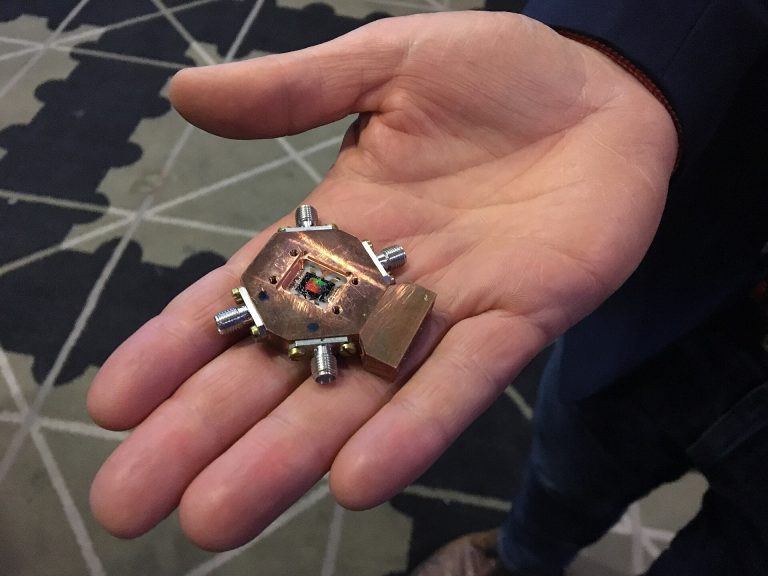
That arrangement avoids extra qubit-moving operations and additional helper qubits. The tested circuits reached a depth of 19 two-qubit operations. Daniel Bultrini, the Moth researcher who developed Tessa, said data loading has been a bottleneck for fields such as quantum machine learning. He said the technique uses the chip’s capabilities so the whole processor can work at once.
Image experiments encoded 784 and 441 values, using 728 and 428 controlled operations, respectively. Each experiment used 8,192 measurement attempts. The largest color image had a correlation of 0.69 with its source, compared with 0.95–0.96 for simpler images.
Reconstruction Results Varied Across Tests
Average numerical error measured 0.130 on Phoenix and 0.131 on IBM’s Fez processor. An adjustment reduced those figures to 0.075 and 0.078, but it used two statistics from the original image. That means the improved reconstruction depended partly on information already known.
A separate test combining image brightness and color produced Phoenix errors of 0.152 and 0.092. Fez recorded 0.144 and 0.084. The Phoenix brightness error was 2.6 times higher than the company’s noise model predicted, suggesting that the real hardware added inaccuracies absent from that model.
Moth also tested audio, musical notes, DNA and protein sequences using different data representations. A test containing 347 flute notes recovered 18.7% of pitches correctly before adjustment and 49.3% afterward on Fez. Biological-sequence results ranged substantially: p53 reached 71.5% correct recovery, Sonic hedgehog reached 76.2%, and mitochondrial protein MT-CO3 recorded 92.3% on Phoenix. SUR1 reached 22.6%, while pikachurin reached 25.8%.
More Work Needed Before Dependable Recovery
The biological tests used 32,768 measurement attempts, four times the image experiments’ 8,192 attempts. The study cautioned that one incorrect DNA or protein unit can matter biologically, so these percentages do not establish dependable medical applications. It also said the simulations omitted some interference between neighboring processor groups, and the hardware tests used no error-correction techniques.
Tessa relies on a particular pattern of qubit connections, while measurement demands rise sharply as the number of those connections grows. Moth did not use error mitigation, which the study says could reduce reconstruction errors in future hardware tests. The company’s record therefore marks progress in moving data through quantum hardware, while the reported error rates and testing limits remain central to what the result establishes. Readers following related work on quantum computing’s broader technology context can also read coverage of new computing models. Related reading on computational approaches to biological research includes Smartech Daily’s report on AI models and digital twins. Its hardware coverage also includes Microchip’s acquisition of VORAGO Technologies.