


The transition from traditional creative processes to AI-augmented workflows is often described in abstract terms, but the real story of modern innovation is found in the moments when technology saves a project from the scrap heap.
We are living through a period where the barrier between a great idea and a finished product is thinner than it has ever been. Few stories illustrate this shift as clearly as that of Elvin Cena.
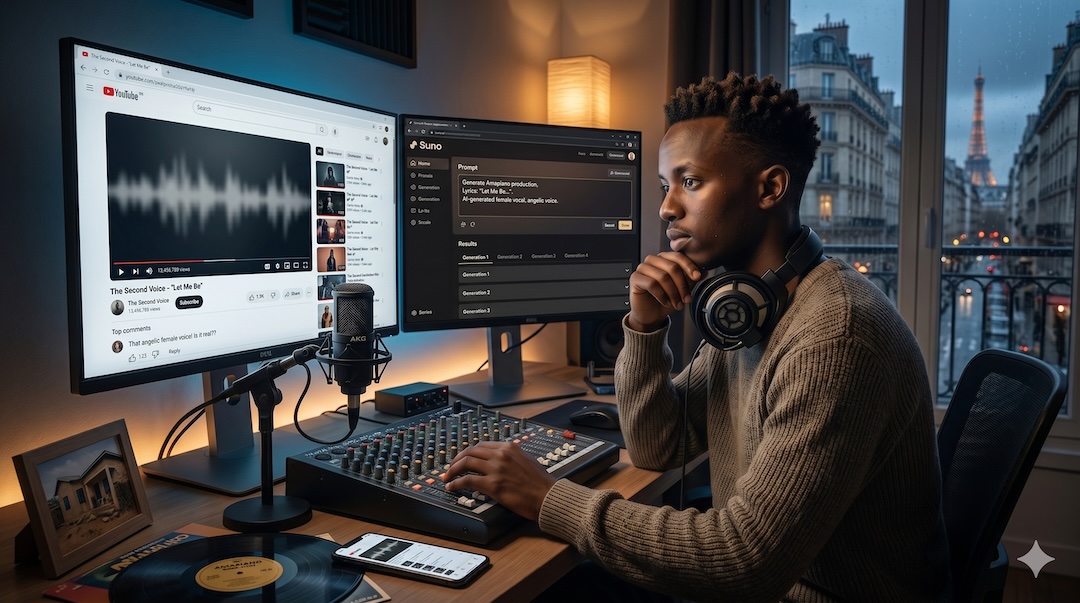
As a twenty-one-year-old artist from Rwanda studying in France, Elvin found himself in a situation that every creator eventually faces. He had the vision and the raw talent, but his professional studio session resulted in a track that simply did not match the sound in his head. While many artists would have felt defeated, Elvin chose to integrate Suno AI into his creative process.
The Frustration of the Traditional Studio
The story began with a track called Let Me Be, which Elvin had recorded in a traditional studio. Despite the professional setting, the final production felt flat and failed to capture the emotional depth he was aiming for. This is a common bottleneck where the cost of re-recording can be prohibitive for an emerging artist.
In the old world of music, a failed studio session was often the end of the road. You either had the money to fix it, or you had a file that sat gathering digital dust.
Elvin refused to let his dream die on his hard drive. His decision to pivot toward artificial intelligence marks a significant turning point in how we think about the relationship between human intent and machine execution.
A New Kind of Creative Pivot
Instead of letting the project die, Elvin experimented with Suno AI, a tool often misunderstood as a simple replacement for human talent. In reality, Elvin used it as a sophisticated collaborator. He did not just ask the AI to generate a random song. Instead, he uploaded his original vocal ideas and the core structure of the song into the platform, then began the iterative process of prompting and tweaking.
He was not looking for the AI to do all the work, but rather to provide the missing pieces that the traditional studio session failed to deliver. This is the essence of the modern creative workflow, where the human provides the soul and direction while the machine provides the technical execution.
Moments like this are exactly why I spend time as an AI keynote speaker. Because most people don’t realize how early we are until they see it happen in front of them.
The 30-Minute Workflow that Changed Everything
Perhaps the most staggering part of this story is the efficiency. Elvin did not spend months in a lab. He transformed his failed studio recording into a professional-grade track in about thirty minutes.
This speed is a game-changer for independent artists working around full-time jobs or university schedules. A rapid workflow allowed Elvin to move from frustration to publication almost instantly. He was able to polish the track and release it while the creative spark was still fresh.
In the music industry, momentum is everything, and the ability to iterate quickly means an artist can respond to trends without the lag of traditional production. Elvin proved that a laptop and a well-defined process can outperform a million-dollar studio when used with intention.
Beyond the Hype: The Real World Results
The impact was immediate. When the final version of Let Me Be was released, it exploded, hitting the number twelve spot on the French YouTube charts and reaching the top ten in Kenya and Tanzania.
More than thirteen million views later, with over fifty thousand unique TikTok videos using the sound, Elvin proved that high-quality production could be achieved without a legacy record label.
These numbers validate a new business model for creators. When a student in a dorm room can produce a global hit that competes with major label artists, the gatekeepers have officially lost their monopoly on distribution and quality.
What This Means for Your Own Creative Journey
You might not be a musician, but the lessons from Elvin’s journey apply to every professional. Whether you are writing a book, designing a website, or building a marketing campaign, the tools of artificial intelligence are here to help you bridge the gap between your resources and your vision.
Stop viewing these tools as a replacement for your effort and start viewing them as a way to enhance your unique human voice. Just as Elvin used Suno AI to fix a failed session, you can use AI to overcome the bottlenecks in your own projects.
The human element remains at the center. Elvin had to have the taste to know the studio version was not good enough, and the persistence to tweak the prompts until they were perfect.
Finding Your Second Voice
As we look toward the future of work and creativity, stories like Elvin’s will become the norm. We are entering an era of democratized production where the only limit is our willingness to experiment. Elvin Cena found his second voice through a combination of Rwandan heritage and cutting-edge technology. He did not let a bad day in the studio define his career, and neither should you. Embrace the workflow, trust your vision, and do not be afraid to use the machines to help you sing your own song.